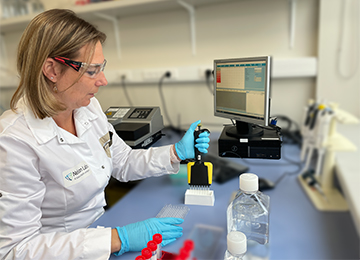



Header Artwork

Recombinant Bacterial Endotoxin Testing

A Sustainable Alternative through rCR

Partner With Us

Recombinant BET Backed by Nelson Labs Expertise

Nelson Labs helps manufacturers evaluate whether recombinant BET is appropriate for their product, process, material, or release testing needs. Our team brings deep experience in bacterial endotoxins testing, method suitability, medical device and pharmaceutical testing, and regulatory compliance.

When you partner with Nelson Labs, you gain support for more than a test result. You gain a team that can help you understand the method, evaluate product-specific considerations, plan the transition, and generate testing data with confidence.

rCR Endotoxin Test Methods & Options

Below is an overview of our core testing methods. If your project requires a tailored approach,
our team is available to work with you to address your specific needs.

Test Method
Test Description
Recommended Sample Size*
Turnaround Time*
LAL120 Recombinant Cascade Reagent (rCR) Endotoxin Testing
rCR Kinetic Chromogenic Testing at a sensitivity of 0.001 EU/mL. Includes validation to confirm the sample matrix does not interfere with endotoxin detection.

Sample Size

Medical devices: No less than 10 samples; Pharmaceuticals: 3 samples (beginning, middle, end of batch); Water: 5 mL preferred (1 mL minimum).

Turnaround Time*

4-6 days, with GLP & expedited options available
LAL155 Kinetic Method Suitability Assay
Typically performed for pharmaceutical products and other complex sample matrices to verify that the selected method can accurately and reliably detect endotoxins without sample-related interference.

Sample Size

Variable

Turnaround Time*

7 days

*Sample size and turnaround time are general guidelines. Actual requirements and timelines may vary based on product type, 
testing complexity, sample preparation needs, and regulatory considerations.

Move Beyond LAL with Confidence

If you are evaluating rCR testing for a medical device, pharmaceutical product, biologic, or other regulated material, Nelson Labs can help you determine whether recombinant BET is the right fit.

Complete the form below, or contact one of our regional offices directly by email.

Frequently Asked Questions

How is recombinant BET different from traditional testing?

Traditional endotoxin testing uses limulus amebocyte lysate (LAL), which is derived from horseshoe crabs. Recombinant BET uses non-animal-derived recombinant cascade reagents (rCR). This type of recombinant endotoxin testing is designed to detect endotoxins through a recombinant version of the enzymatic cascade used in traditional LAL methods.

Both methods are used to detect bacterial endotoxins, but recombinant BET may better support sustainability goals and reduce reliance on animal-derived reagents.

Will traditional LAL testing be discontinued?

No. Recombinant BET gives manufacturers an additional testing option. Depending on the product, process, regulatory pathway, and internal quality strategy, recombinant BET may be used as an alternative method to traditional LAL-based BET.

Nelson Labs can help you evaluate whether recombinant BET is appropriate for your specific testing needs.

What products can be tested using recombinant BET?

Recombinant BET may be appropriate for a range of products and materials that require bacterial endotoxins testing, including:

  • Medical devices
  • Pharmaceutical products
  • Biologics
  • Combination products
  • Raw materials
  • Process materials
  • Water systems
  • Other regulated materials requiring endotoxin assessment

Product type, sample matrix, regulatory expectations, and intended use should all be considered when determining whether recombinant BET is the right fit.

What if my product contains beta glucans?

Beta glucans can potentially be found in products that contain cellulose or other plant-based materials such as cellulose acetate filters and cotton plugs, as well as sucrose-containing buffers or starting materials.  

Products that contain beta glucans can utilize the rCR test method; in fact, this method is helpful because it replicates the full traditional test cascade without any interference from beta glucans. 

Does rCR testing require validation or method suitability?

Yes. As with bacterial endotoxins testing generally, product-specific suitability must be addressed to confirm the method can accurately detect endotoxins in the presence of the test article, extract, or sample matrix.  

Nelson Labs can help customers understand method suitability requirements, evaluate potential inhibition or enhancement, and generate appropriate documentation for their testing program.  

Is rCR the same as rFC?

No. Both rCR and rFC are recombinant, nonanimal-derived reagent approaches for bacterial endotoxins testing, but they are not the same method. 

rFC uses recombinant Factor C, a single enzyme, to detect the presence of endotoxins by measuring a change in fluorescence. rCR uses the full enzymatic cascade used in traditional LAL testing to detect the presence of endotoxins. Similar to traditional chromogenic endotoxin testing, rCR measures a change in color. 

Nelson Labs can help you understand which recombinant approach may be most appropriate for your testing needs. 

Why are manufacturers moving toward recombinant endotoxin testing?

Manufacturers are evaluating recombinant endotoxin testing for several reasons, including sustainability, supply chain resilience, reduced reliance on animal-derived reagents, and alignment with evolving regulatory and compendial expectations.   

For many organizations, recombinant BET is part of a broader effort to modernize quality control testing while maintaining patient safety and regulatory confidence.  

Can Nelson Labs help me transition from traditional LAL to recombinant BET?

Yes. Nelson Labs can help customers evaluate the feasibility of recombinant BET, understand method suitability needs, plan documentation, and determine whether rCR testing is appropriate for their product or process.

Because endotoxin testing decisions can have regulatory and quality implications, Nelson Labs recommends involving testing, quality, regulatory, and technical stakeholders early in the transition process.

Where is the recombinant BET test available?

rCR is currently available at our lab in Salt Lake City, Utah, and coming soon to our lab in Itasca, Illinois.

Contact Nelson Labs to discuss your product, sample type, timing, and regulatory requirements so our team can recommend the right path forward.  

Is recombinant BET recognized by USP?

Yes. USP <86>, Bacterial Endotoxins Test Using Recombinant Reagents, provides methods for bacterial endotoxins testing using recombinant reagents.

At this time, USP describes the methods in Chapter 86 as alternatives to Chapter 85, Bacterial Endotoxins Test. This means manufacturers should plan for appropriate method suitability, verification, and documentation when adopting recombinant BET. Nelson Labs’ testing and regulatory experts can support this process.

What standards can be referenced for recombinant testing?

The test references USP <86> Bacterial Endotoxins Test Using Recombinant Reagents. For medical devices, the following will also be referenced: USP<161> Medical Devices – Bacterial Endotoxin and Pyrogen Tests, ANSI/AAMI ST72 Bacterial Endotoxins – Test Methods, Routine Monitoring, and Alternatives to Batch Testing, and ISO 11737-3 Sterilization of health care products – Microbiological Methods Part 3: Bacterial endotoxin testing. 

How is rCR currently viewed from a regulatory perspective?

Per USP recombinant testing is currently official but not yet applicable; this means that there is an official test standard (USP <86>), but it is not yet referenced in General Notices or other monographs. It is therefore considered an alternative method. 

Per Ph. Eur. 2.6.32 rFC testing is an official method for endotoxin testing for water and is referenced in relevant monographs, such as Water for Injections (0169) and Purified Water (0008). For product testing it is considered an alternative method.