Study Outline
Bacterial Filtration Efficiency (BFE)
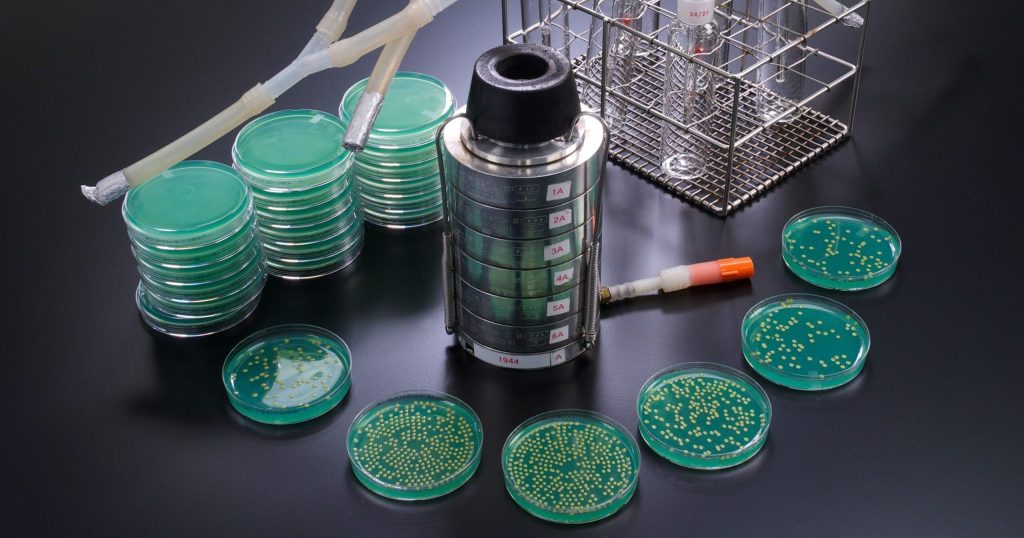
The Bacterial Filtration Efficiency test determines the filtration efficiency by comparing the bacterial control counts to test article effluent counts. The test is conducted using Staphylococcus aureus as the challenge organism. After the filtration media is preconditioned, a liquid suspension of S. aureus is aerosolized and delivered to the filtration media at a constant flow rate of 28.3 liters per minute (LPM) or 1 cubic foot per minute (CFM).
The aerosol droplets are drawn through a six-stage Andersen sampler for collection. The number of bacterial aerosol droplets contacting the filter media is determined by conducting challenge controls without filter medium in the test system. Challenge controls are maintained at 1700 – 3000 colony-forming units (CFU) with a mean particle size (MPS) of 3.0 ± 0.3 µm. This allows filtration efficiencies to be reported up to >99.9%.
The BFE test offers a number of advantages over other filtration efficiency tests. It has been used with little or no modification for years and provides a standard reference for comparison of filtration materials. The mean particle size can be tightly controlled and is sized using a six-stage viable-particle Andersen sampler, permitting stage-by-stage analysis. The BFE procedure is reproducible, and provides a more severe challenge to most filtration devices than would be expected in normal use. Large numbers of material can be evaluated in a relatively short time.
BFE testing is commonly performed along with the Differential Pressure (Delta P) test.
For housed filters, we recommend the Increased Challenge method. This procedure uses a higher concentration of challenge to be delivered to each test material. Filtration efficiency measurements can be determined up to >99.9999%.
Increased Challenge Bacterial Filtration Efficiency (BFE)
The Increased Bacterial Filtration Efficiency test determines the filtration efficiency by comparing the bacterial control counts to test article effluent counts. The test is conducted using Staphylococcus aureus as the challenge organism. A liquid suspension of S. aureus is aerosolized and delivered to the filtration media at a constant flow rate of 30 liters per minute (LPM).
The aerosol droplets are collected in all-glass impingers (AGIs) in parallel. The challenge is delivered for a one-minute interval and sampling through the AGIs is conducted for two minutes to clear the aerosol chamber. The titer of the assay fluid is determined using standard plate count and/or membrane filtration techniques. The number of bacterial aerosol droplets contacting the filter media is determined by conducting challenge controls without filter media in the test system. Challenge controls are maintained at ≥ 1 x 10⁶ colony-forming units (CFU) with a mean particle size (MPS) of 3.0 ± 0.3 µm. This allows filtration efficiencies to be reported up to >99.9999%.
The Increased BFE testing offers a number of advantages over other filtration efficiency tests. It has been used with little or no modification for years and provides a standard reference for comparison of filtration materials. The Increased BFE procedure is very reproducible, easily performed, and provides a more severe challenge to most filtration devices than would be expected in normal use.
Viral Filtration Efficiency (VFE)
The Viral Filtration Efficiency (VFE) test follows the same procedure as BFE, except the challenge organism used is the bacteriophage phiX174.
Challenge controls are maintained at 1100-3300 plaque-forming units (PFU) with a mean particle size (MPS) of 3.0 ± 0.3 µm. This allows filtration efficiencies to be reported up to >99.9%.
Increased Challenge Virus Filtration Efficiency (VFE)
The Increased VFE test follows the same procedure as BFE, except the challenge organism used is the bacteriophage phiX174.
Challenge controls are maintained at ≥1×10⁶ plaque-forming units (PFU) with a mean particle size (MPS) of 3.0 ± 0.3 µm. This allows filtration efficiencies to be reported up to >99.9999%
Shipping requirements: Ambient
Testing Locations
Learn more about our locations and their certifications.
Contact Us
If you have additional questions, contact one of our global offices by email or phone.
Europe
Email:
[email protected]