

Blog Post 7 – When Formulation Tweaks Reveal Hidden Chemistry: A Case of Unexpected Impurities
2 min reading time
Recently, a customer reformulated a drug product containing a well-characterized Active Pharmaceutical Ingredient (API). Routine High-Performance Liquid Chromatography/Ultraviolet (HPLC/UV) analysis flagged something unusual: a new, unidentified impurity appeared in the chromatogram. Intriguingly, it eluted very close to a known impurity of the API—raising immediate questions.
The client suspected a structural similarity, and our team dove into comparative analysis. We examined the API, the known impurity, and the newcomer. The results? Remarkably similar fragmentation patterns across all three. But there was a twist: both the known and unknown impurity showed a higher molecular mass than the API.
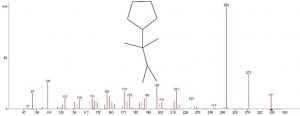
Figure 1: LC/UV spectrum of the routine QC method containing the unknown impurity

Figure 2: LC/MS chromatogram with a differential MS peak associated to the unknown impurity

Figure 3: Mass spectrum of the differential MS peak
Using high-resolution mass spectrometry (HRMS), we pinpointed the differences—one impurity carried an extra H₂O, the other an H₂O₂. This revealed the presence of hydroxy and hydroperoxy derivatives of the API, likely formed during or after the formulation change.
This case beautifully illustrates how subtle formulation changes can lead to unexpected chemical transformations—and how advanced analytical techniques like high resolution mass spectrometry empower us to uncover them with precision.
Science in action. Curiosity rewarded. Another reminder of why we love what we do.
If you have additional questions about Impurities Identification test services or would like to consult with the experts at Nelson Labs, just send an e-mail to [email protected].