

Blog Post 8 – The Case of the Vanishing Thickness: How NMR Solves the Impurity Mystery
2 min reading time
In pharmaceutical manufacturing, even the smallest modifications to packaging can have significant consequences. In a recent project, a minor reduction in the thickness of the packaging led to the appearance of an unexpected impurity. Our investigation revealed that this alteration allowed a leachable component from the packaging system to migrate more readily, ultimately reacting with an ingredient in the drug product and generating a new impurity.
The impurity was initially detected by our client using liquid chromatography coupled with ultraviolet detection (LC/UV). The sponsor’s LC/UV method was then transferred to our high-end LC/MS platform, enabling high-resolution mass spectrometry-based characterization. From the LC/MS studies, we determined that the impurity was a reaction product arising from the interaction of a leachable compound and a constituent of the drug product. While LC/MS provided valuable insights into the molecular mass and fragmentation patterns—linking the impurity to two known compounds—it could not clarify how these compounds interacted to form the final product.
To address this gap, we worked together with our network to perform additional NMR experiments, including advanced techniques, like HSQC (Heteronuclear Single Quantum Coherence), HMBC (Heteronuclear Multiple Bond Correlation) spectroscopy and COSY (Homonuclear COrrelation SpectroscopY). NMR revealed the precise atomic connectivity and chemical environment within the molecule. This allowed us to pinpoint exactly how the reaction occurred at a structural level, information that LC/MS alone could not offer. Since we found out how the impurity could be synthesized, we were able to produce the impurity on a larger scale and therefore we could conduct detailed NMR experiments, ultimately confirming both its identity and the formation pathway.
Through our network of expert partners, we gain access to advanced analytical platforms such as NMR. At Nelson Labs, we apply a multidimensional strategy to impurity characterization — combining deep knowledge of potential leachables with techniques like LCMS, NMR, and others. This integrated approach allows us to detect, identify, and manage unexpected contaminants, supporting the highest standards in pharmaceutical quality control.
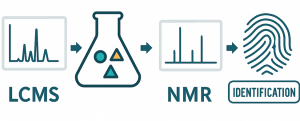
Figure 1: Overview of different steps for identification via the combination of LCMS and NMR
If you have additional questions about Impurities Identification test services or would like to consult with the experts at Nelson Labs, just send an e-mail to [email protected].